

Why Flights From the U.S. to Canada Are Often Cheaper Than the Other Way Around

If you’ve ever searched transborder flights and thought, “Wait… how does this make sense?” — you’re not alone.
Recently, I spotted a one-way Las Vegas → Vancouver flight for just $32 CAD on Flair Airlines on January 16, 2026.
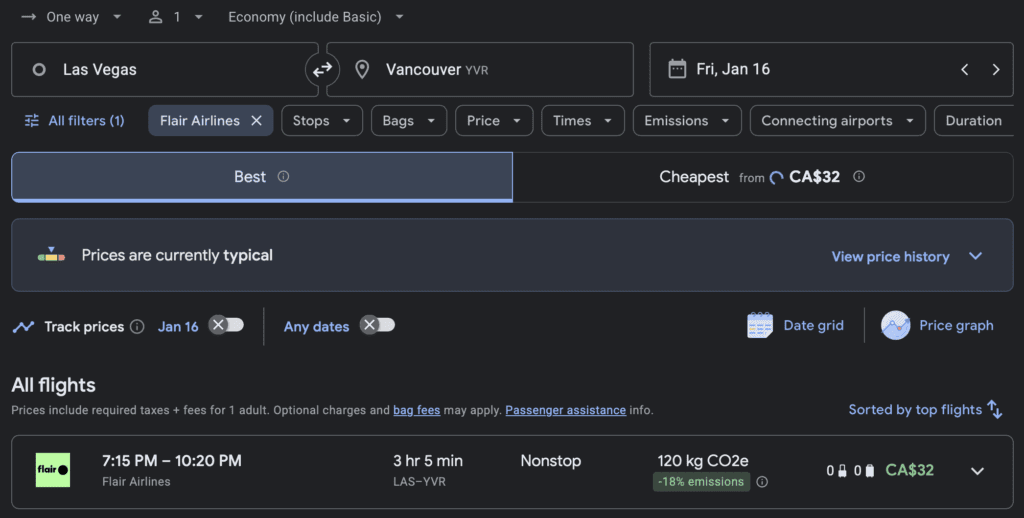
Out of curiosity, I checked the exact same route on the same date in reverse — Vancouver → Las Vegas — and the cheapest option jumped to $118 CAD.
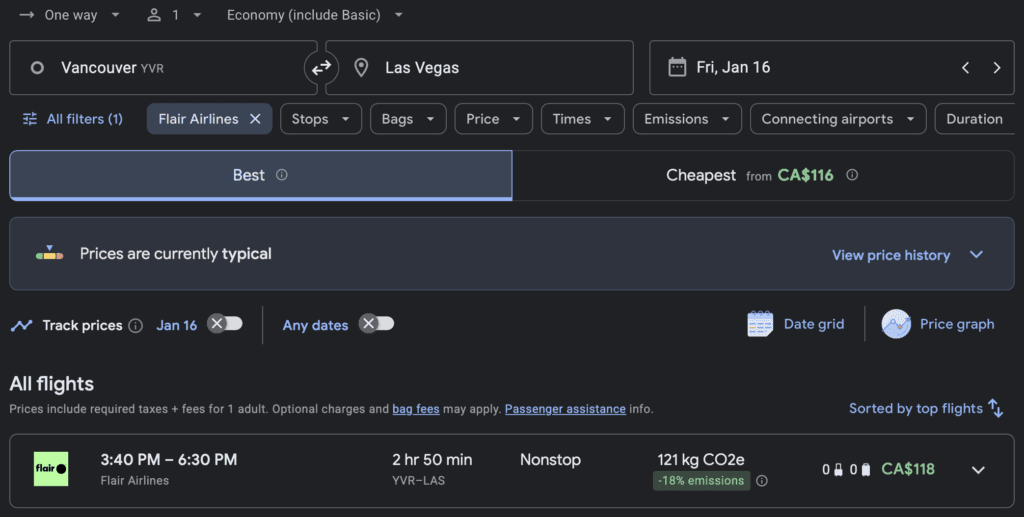
Same airline. Same distance. Same aircraft.
So what gives?
As it turns out, this isn’t a pricing fluke or a one-off deal — it’s part of a larger trend that affects many flights between Canada and the U.S. And once you understand why it happens, you’ll be able to spot (and take advantage of) these price gaps far more often.
The Short Answer: It’s Not the Flight — It’s Where It Starts

In most cases, flights originating in the U.S. are cheaper than flights originating in Canada, even when the route is identical.
The reason comes down to three big factors:
- Higher taxes and fees on Canadian departures
- More competition (and more ULCCs) in the U.S.
- Different pricing strategies depending on the direction of travel
Let’s break it down.
1. Canadian Flights Are Loaded With Higher Mandatory Fees

One of the biggest reasons flights leaving Canada cost more has nothing to do with the airline — it’s baked directly into the ticket.
Flights departing Canadian airports are subject to a wide range of mandatory charges, including the Air Travellers Security Charge (ATSC), airport and transportation taxes, and multiple cross-border government fees when flying to the U.S. These costs are passed directly to passengers and can quickly dwarf even the cheapest base fares.
For example, let’s look at the fees applied to the Las Vegas → Vancouver vs. Vancouver → Las Vegas flight.
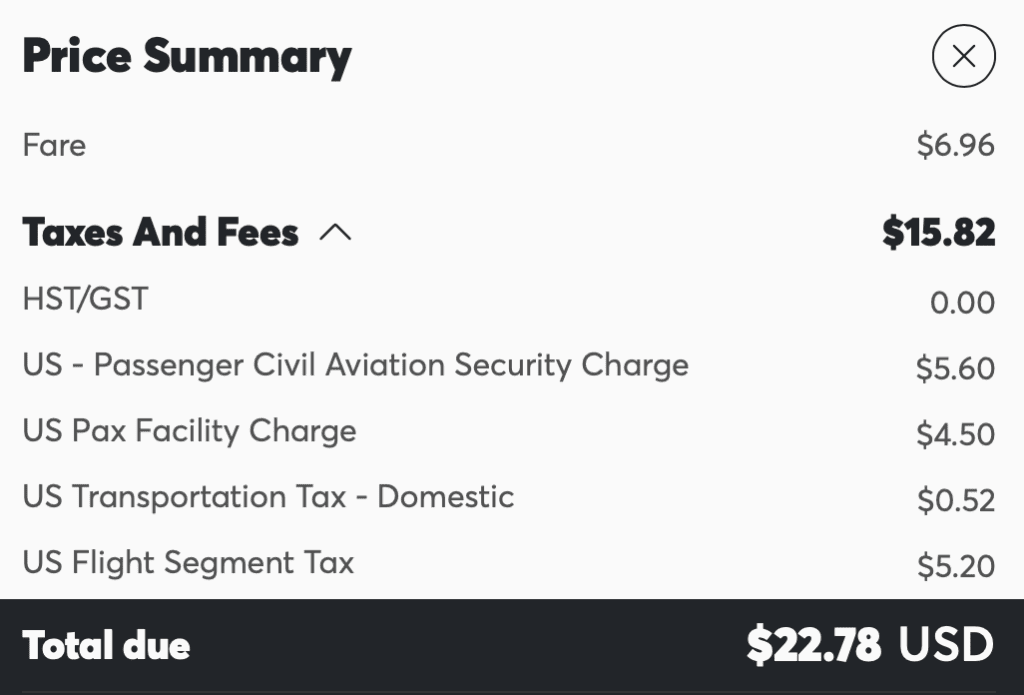
vs.
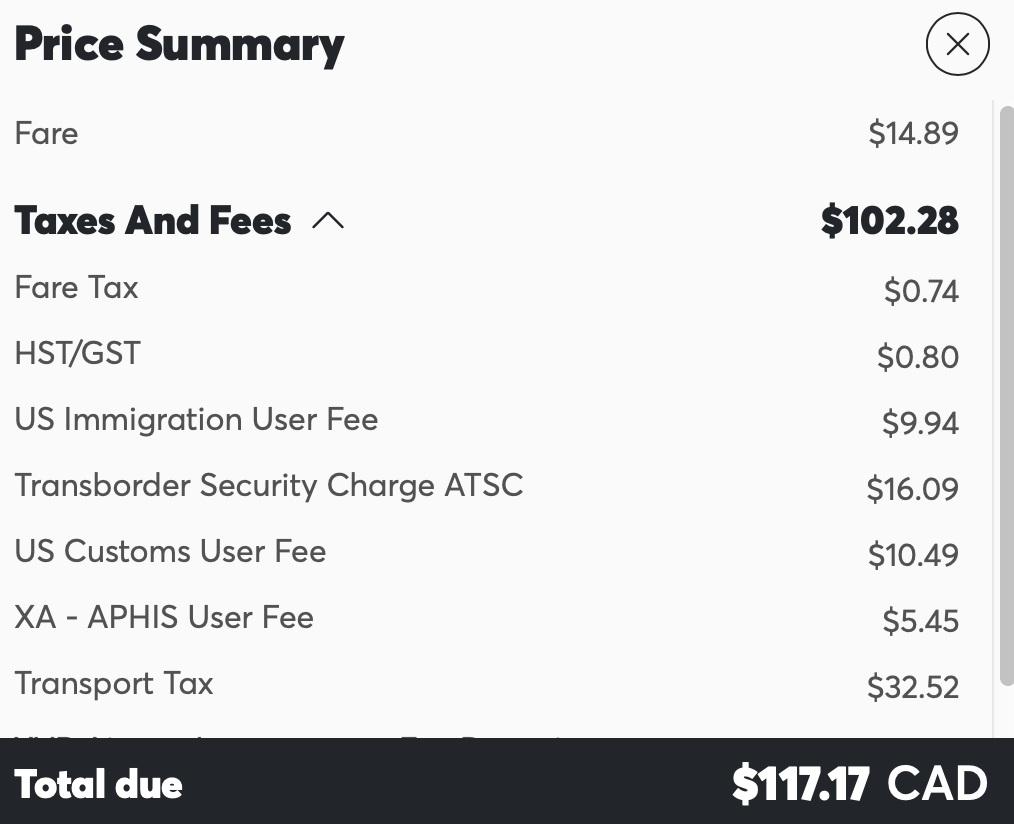
As you can see, on ultra-low-cost airlines like Flair, it’s not uncommon to see a base fare under $20 CAD — with taxes and fees exceed $100 when departing Canada.
By comparison, flights leaving U.S. airports are subject to lower, standardized, and capped federal charges, which gives airlines far more flexibility to advertise eye-catching prices on U.S.-originating flights.
2. The U.S. Has Way More Airline Competition

The U.S. airline market is brutally competitive — and that’s great news for travellers.
On the American side, airlines are constantly fighting for market share, including ultra-low-cost carriers like:
- Frontier
- Spirit
- Allegiant
- Breeze
Even when these airlines aren’t flying the exact same route, their presence puts downward pressure on prices across the board — including transborder flights.
Canada, on the other hand, has a much smaller airline market. With fewer competitors and limited overlap from U.S. ULCCs, airlines don’t face the same pressure to undercut each other on flights leaving Canada.
The result? Lower fares heading north — higher fares heading south.
3. Airlines Price Flights Based on Direction, Not Distance

This part surprises a lot of people: airlines don’t price flights based purely on distance or cost to operate.
They price based on:
- Where demand is strongest
- Who they’re competing against
- What travellers in that market are willing to pay
For leisure-heavy routes like Las Vegas → Vancouver, airlines often need to stimulate demand on U.S. departures — especially midweek or during slower seasons. That’s when you see absurdly cheap fares like $32 one-way.
But on the return leg — Vancouver → Las Vegas — demand from Canadian travellers is often stronger, competition is weaker, and fees are higher. Airlines know they don’t need to discount as aggressively.
Same route. Very different pricing logic.
So… Are Flights From the U.S. to Canada Usually Cheaper?

In many cases, yes.
Especially when:
- You’re flying transborder
- You’re looking at low-cost carriers
- You’re comparing one-way fares
- The U.S. departure airport has strong ULCC competition
This is also why many Canadians who live near the border choose to fly out of U.S. airports like Bellingham, Buffalo, or Seattle — the savings can be substantial.
How Canadian Travellers Can Use This to Their Advantage

Here are a few smart strategies to keep in mind:
✈️ Check both directions
If you’re booking one-way flights (or open-jaw itineraries), always compare prices starting in the U.S. vs Canada.
🔄 Mix and match carriers
Sometimes the cheapest option is flying into Canada on a ULCC, then returning with a different airline or using points.
💳 Pair cheap cash fares with points
Ultra-cheap U.S. → Canada flights are often perfect candidates for cash — save your Aeroplan or Avios points for the more expensive Canada → U.S. leg.
📅 Be flexible with timing
These price gaps are most dramatic on off-peak days, shoulder seasons, and midweek flights.
The Bottom Line

If you’ve noticed flights from the U.S. to Canada looking suspiciously cheap — you’re not imagining things.
Between higher Canadian departure fees, less competition, and directional pricing strategies, it’s often cheaper to fly north than south, even on the exact same route.
And once you know what to look for, deals like $32 Las Vegas → Vancouver stop feeling like magic — and start feeling like opportunity.


Follow me on Instagram and Tiktok for travel tips hacks that’ll make your adventures unforgettable!
@thecanadianjetsetter on INSTAGRAM →
@thecanadianjetsetter on TIKTOK →
follow me ON Instagram →
FOLLOW me on tiktok →


Comments will load here
Be the first to comment